The Pillow Guide
Inside a Latex Pillow: Firmness, Loft, and Fit Explained
A pillow can look perfectly composed on the bed and still feel entirely wrong at midnight. With latex, the difference often comes down to three details: how high the pillow sits, how firmly it resists pressure, and whether its shape suits the way you sleep. Here’s how to read those details—and choose a pillow that feels like it belongs in your nightly routine.
Published November 7, 2026
Latex pillows have a particular appeal: they tend to spring back after pressure, hold their shape more readily than loose-fill pillows, and offer a buoyant feel that is distinct from the slow, yielding sensation of many memory-foam designs. But “latex” is not a complete description of how a pillow will feel. Two pillows made from latex can differ substantially in height, firmness, contour, ventilation, and the way they respond when you settle in.
The right choice is not necessarily the firmest or the tallest. It is the one that helps your head and neck rest in a comfortable, neutral position, while still feeling pleasant enough that you are not constantly adjusting it. Sleep position offers a useful starting point, but mattress feel, shoulder width, body proportions, and personal preference all enter the picture. Think of pillow shopping less as a search for a universal ideal and more as a careful fitting.
This guide explains the language used to describe latex pillows, how firmness and loft work together, and what to consider for side, back, and stomach sleeping. It also looks at construction, care, and practical questions to ask before choosing a pillow.
What makes a latex pillow feel different?
Latex is a resilient foam material made from natural rubber latex, synthetic latex, or a blend. Natural latex comes from the sap of rubber trees; synthetic versions are produced from petrochemical ingredients. A product’s label should clarify what kind of latex it contains rather than relying on the word “latex” alone. The material’s feel also depends on the manufacturing process, density, shape, and any ventilation or contouring built into the design.
In use, latex is often described as buoyant. Rather than allowing the head to sink deeply and slowly, it generally compresses and pushes back with a springier response. That quality can make repositioning feel easy, though some sleepers may prefer the softer, more enveloping sensation of down, fiberfill, or memory foam. There is no hierarchy of comfort here; the important question is whether a pillow’s response feels supportive or distracting to you.
Many latex pillows are made as a single molded piece, while others use shredded latex that can be rearranged or removed. A solid core tends to have a more consistent shape and feel. Shredded fill can offer more adjustability, although it may need occasional redistributing to keep the pillow feeling even. Some models have a shaped profile, such as a dip for the head or a raised edge, while others use a traditional rectangular form.
Latex may be perforated or otherwise designed with openings to encourage airflow. These features can affect how the pillow feels, but they do not guarantee that every sleeper will feel cool. Room temperature, bedding, humidity, and individual comfort all matter. If heat is a concern, consider the entire sleep setup rather than treating one material feature as a promise.
Firmness: resistance, not height
Firmness describes how much resistance a pillow offers when you press into it. It is not the same thing as loft, which describes the pillow’s height. A pillow can be relatively low and firm, or lofty and soft; the terms are related in the experience of using a pillow, but they measure different qualities.
Firmness labels are not perfectly standardized across brands. “Medium” on one product may feel quite different from “medium” on another, and a pillow’s feel can change with the sleeper’s weight, how centrally they lie, and the mattress beneath them. A firmer mattress, for example, may allow less shoulder sink than a softer one. That can affect how much space remains between the head and mattress, and therefore how high a pillow needs to be.
A latex pillow’s resilience may also make its firmness feel more immediate than that of a material that slowly conforms. You may feel the pillow’s pushback as soon as you rest your head. For some, that is a welcome sense of lift; for others, it can seem too springy or substantial. If possible, check a retailer’s trial and return terms, and test the pillow in your usual sleep position rather than judging it with a brief squeeze in the showroom.
Firmness should not be confused with support. A pillow can feel firm in the hand yet be the wrong shape or height for a particular sleeper. Support is better understood as the way the pillow holds the head and neck in relation to the rest of the body. Comfort is the combined result: the pillow should feel agreeable while allowing you to settle without strain or a persistent need to prop, fold, or flatten it.
Loft: the height that changes everything
Loft is the pillow’s height, usually considered while it is resting under the head rather than simply measured on a shelf. The important detail is how much height remains after the pillow compresses. A lofty pillow can feel lower once loaded, while a denser design may keep more of its original shape. Measurements can help with comparison, but they cannot fully describe that in-use experience.
As a general principle, the pillow should fill the space between the head and mattress without pushing the head sharply upward or allowing it to fall too far down. When lying on your side, the head is usually best kept in line with the spine rather than angled toward the mattress or ceiling. On your back, the pillow should support the natural curve of the neck without forcing the chin toward the chest or tipping the face markedly upward. Individual anatomy and mattress softness influence what that looks like in practice.
Sleep position is a useful guide, not a rigid rule. A person who changes positions through the night may need a middle ground that works reasonably well across several postures. Some may prefer an adjustable shredded-latex pillow so they can remove or redistribute fill. Others may value the stable shape of a solid core. The best option depends on how much adjustment you want and whether you tend to remain in one position or move frequently.
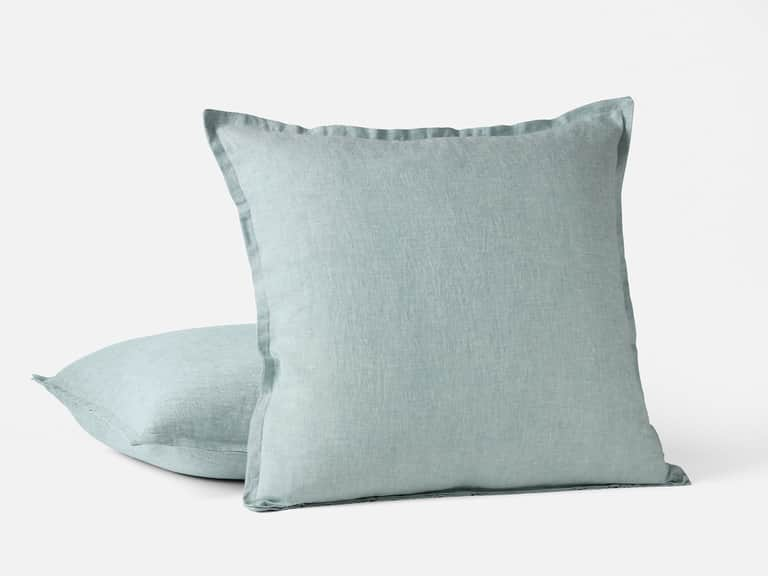
When comparing loft, look for clear product specifications and ask whether measurements refer to the pillow before or after compression. Consider the dimensions of the pillowcase as well: a case that is too tight can compress the fill, while excess fabric can bunch and make the pillow feel less orderly. A well-fitting case should allow the pillow to sit naturally without pulling hard at the seams.
A sleep-position guide to pillow fit
Side sleepers
Side sleeping usually creates a larger gap between the mattress and the head than back or stomach sleeping. The width of the shoulders and the degree to which they sink into the mattress affect that distance. A pillow with enough loft to bridge the space may help keep the head level with the spine. If it is too low, the head may angle down; if it is too high, it may angle upward. Neither sensation should be treated as a diagnosis, but either may signal that the fit is not comfortable.
Side sleepers often look for a pillow that resists collapsing completely under pressure. A firmer or more supportive-feeling option may maintain its shape, but high firmness alone does not guarantee a good fit. Check the pillow’s actual height and whether its shape accommodates the way you position your shoulder and head. If you alternate sides, a symmetrical design may feel simpler than a sculpted pillow with a distinct left-to-right orientation.
Back sleepers
Back sleepers commonly need a pillow that supports the head without lifting it too far forward. A moderate loft may suit some people, but the appropriate height depends on neck shape, mattress response, and personal comfort. A contoured latex design may appeal to sleepers who like a defined area for the head and additional support near the neck; a traditional shape may be preferable if contours feel restrictive.
Notice whether you feel pressure at the base of the skull or a sense that your chin is being pushed toward your chest. If so, the pillow may be too tall or too firm for your preference. Conversely, if the head seems to fall back and the pillow offers little contact around the neck, you may want to compare a different profile. Small differences in shape can matter more than a broad firmness label.
Stomach sleepers
Stomach sleeping generally puts the head close to the mattress, so a thick, high-loft pillow may feel awkward. Some stomach sleepers prefer a low, softer pillow that does not add much elevation. Others choose to sleep with very little under the head. Latex’s spring and structure can feel more substantial than expected, even in a lower profile, so the product’s stated firmness and compressed height deserve attention.
Because sleep preferences and bodies vary, no position-based recommendation should be treated as a prescription. Choose a pillow that feels comfortable to you, and seek qualified medical guidance if you have ongoing pain, numbness, or other symptoms rather than relying on a pillow change as a substitute for care.
The mattress is part of the equation
A pillow is never experienced in isolation. The mattress changes how far the shoulder and torso settle, which can alter the apparent distance between the head and bed. On a softer mattress, a side sleeper’s shoulder may sink more deeply, reducing the gap a pillow needs to fill. On a firmer surface, less sink may leave a larger gap. This is one reason a pillow that feels comfortable in one bedroom may not feel identical on another bed.
Consider the full arrangement: mattress firmness, sleep position, pillow loft, and how much the pillow compresses. If you are replacing a mattress and pillow at the same time, be aware that changing both can make it harder to identify what improved or worsened your comfort. When possible, change one element at a time and give yourself a reasonable adjustment period, while following the retailer’s trial conditions.
There is also a difference between the pillow’s displayed height and the height you experience after settling. Latex’s rebound means it may retain more loft than a very compressible fill. That quality can be helpful if you like a consistent cushion, but it may not suit someone who wants a pillow that molds closely around the head. A short trial at home can reveal this more clearly than a product description.
Solid latex or shredded fill?
Solid latex pillows have a molded core, sometimes shaped with gentle contours or ventilation holes. Their main appeal is consistency: the fill does not need to be shaken back into place, and the pillow tends to retain a defined profile. The trade-off is that the loft and shape are usually fixed. If the height is not right, there may be limited room to customize it.
Shredded latex pillows contain small pieces of latex within a fabric casing. Depending on the design, fill may be removable, allowing the sleeper to adjust height and firmness. This can be useful when the ideal loft is uncertain or when different positions require different support. However, adjustability is only practical if the pillow is easy to open and the fill can be redistributed without making the surface lumpy. Check whether extra fill is included or available separately.
Neither construction is automatically more durable or comfortable. Build quality, material composition, cover construction, and care all play a role. Read the product information closely: find out whether the latex is natural, synthetic, or blended; whether the pillow has a removable cover; and what cleaning methods are permitted. Latex foam itself often requires different care from the fabric cover, so do not assume the entire pillow can go in a washing machine.
How to assess a pillow in real life
When trying a pillow, settle into your normal position rather than sitting upright or pressing down with your hand. Give the material a few moments to respond, then notice whether your head feels centered and whether you can relax without constantly arranging the fill. If you move between positions, test each one you use regularly. A pillow that feels appealing for a few seconds may behave differently after you have rested on it.
Ask yourself practical questions as well as sensory ones:
- Does the pillow have a stated loft or a useful height range?
- Is the firmness described clearly, and can it be adjusted?
- Is the latex natural, synthetic, or a blend?
- Does it have a removable, washable cover?
- What care does the manufacturer recommend for the core and cover?
- Does the seller offer a sleep trial, and what are the return conditions?
- Are the pillow dimensions compatible with the pillowcase you plan to use?
Look for specific construction details rather than relying solely on lifestyle language. Terms such as “cooling,” “orthopedic,” or “perfect for every sleeper” can be broad and subjective. Ask what the product is made of, what its dimensions are, and how it is intended to be maintained. Transparent specifications make it easier to compare options without mistaking a polished description for a guarantee of personal comfort.
Care, longevity, and everyday use
Follow the care label before washing or airing a latex pillow. Many latex cores should not be machine-washed or soaked; excessive moisture and rough handling may damage the material. A removable cover is often the easiest layer to launder regularly. If the core needs freshening, consult the manufacturer’s instructions rather than applying heat, bleach, or strong cleaning products without confirmation.
A protective pillowcase can help keep the cover clean, while regular airing may help manage everyday freshness. Keep latex away from prolonged direct heat and intense sunlight unless the maker specifically says otherwise. If you use an adjustable shredded pillow, follow the instructions for distributing its fill and closing the casing securely. Small routines, such as smoothing the pillow after use and washing the cover as directed, help keep the sleep surface feeling composed.
Replace a pillow when it no longer feels comfortable or supportive, when its shape has changed significantly, or when the material shows signs of damage. There is no single replacement interval that applies to every pillow: use, care, construction, and personal sensitivity all vary. A durable material can be an advantage, but durability is not the same as a permanent fit. Your comfort may change even if the pillow remains intact.
A considered choice, not a perfect formula
Choosing among latex pillows is a matter of matching feel with fit. Firmness tells you how much resistance the pillow offers; loft tells you how high it sits; construction determines how consistently it holds that shape and whether you can adjust it. Sleep position helps narrow the field, while mattress softness, shoulder width, movement through the night, and personal preference refine the choice.
Start with your most frequent sleep position and the pillow height you currently find comfortable. Then compare products by material, shape, firmness, and compressed loft—not by a single headline claim. If your preferences are uncertain, an adjustable design or a clearly stated trial policy may make the decision easier. Give a new pillow time to assess, but do not ignore persistent discomfort simply because a product is described as supportive.
The ideal pillow is not necessarily the most luxurious, the most sculpted, or the one with the most persuasive claims. It is the one that lets you settle naturally, supports the way you actually sleep, and feels easy to live with night after night. In the end, the most elegant choice is often the one you stop noticing—because it fits.